Soldaten-Norbert
Der goldene HandschuhSoldaten-Norbert is a regular at The Golden Glove Tavern, a former Waffen-SS member and French Foreign Legionnaire whose postwar life is marked by unstable employment, heavy drinking, war trauma, and hearing loss. His nickname identifies the history that follows him into the bar: he can turn an ordinary conversation into a prolonged account of wartime horror, then erupt at a stranger over a glance or an interruption. Through his encounters with Fiete Honka and other patrons, the novel presents him as both a figure consumed by memories of violence and someone who continues to bring violence into the present.
Identity and military history
The name Soldaten-Norbert comes from his service in the Waffen-SS. In April 1945, he became a prisoner of war; from there he entered the French Foreign Legion, whose recruiters were then drawing men from the Wehrmacht and Waffen-SS among those seeking a way out of the prisoner camps. Norbert served in Indochina from 1948 to 1953. The sequence links his escape from captivity to another military life, rather than to a settled return to civilian society.
After leaving the Legion, he could not establish himself in ordinary work. He was employed as a stevedore, night watchman, and laborer, but repeatedly lost jobs, usually because of alcohol. By the time of the tavern episodes, he has recently begun working for the refuse collection service. The job requires early starts and has made him drink somewhat less, but he experiences the change from SS soldier to municipal garbage worker as a harsh descent. Work offers a routine, not a stable recovery from the habits and memories that have shaped his life.
Injury, drinking, and remembered war
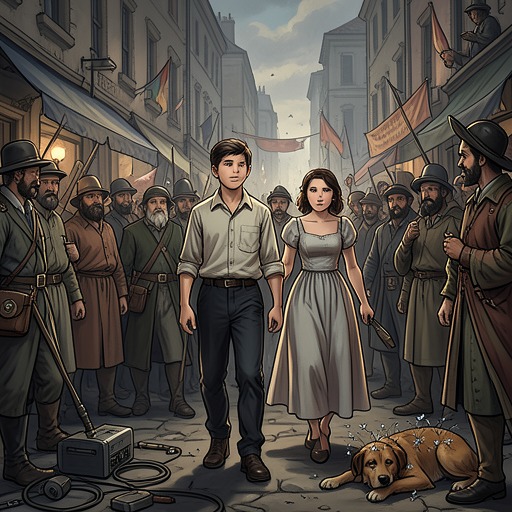
Norbert is hard of hearing and wears a hearing aid. The impairment dates to the war, when something loud was fired close to his ear. At the bar he fiddles with the device and its cable, which hangs down the side of his neck. Herbert once tried to rename him Hearing-Aid Norbert; Norbert did not take the joke well. The episode makes his hearing loss more than a background detail: it is visible in his daily life and becomes a point around which the bar’s system of nicknames and teasing can turn.
His drinking is entangled with work and self-injury. When he wants sick leave from the refuse service, he hits his ankle with an aluminum cane until it swells. He knows that this is self-mutilation and says that the consequences are his own concern; the injury gives him a week in which he can drink heavily without going to work. The practical calculation is bleakly direct: he uses his body to interrupt a job he resents and to make room for the drinking that the job had begun to curb.
At The Golden Glove Tavern, wartime memory can take over without warning. In one long account to Fiete, Norbert describes his comrade Peter, whose legs were broken repeatedly until his calves shrank from disuse. Despite his condition, Peter was not sent home; he was returned to the front and killed by a shot that destroyed his head. Norbert’s description dwells on the ruined body and the blood. He continues for five, ten, then fifteen minutes before falling silent in a vacant delirium. The narrative describes the war experiences as indelibly burned into him, as though memory were consuming him from within. His account is not a composed history of the war but a scene in which the past overwhelms the present conversation.
Place in the tavern and relation to Fiete
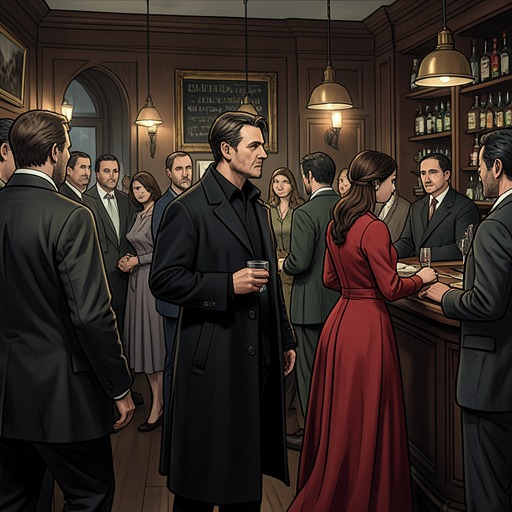
The bar gives Norbert a regular audience, but not necessarily an attentive one. Fiete would rather refuse Norbert’s offer to buy him a drink than be trapped in one of his notorious endless monologues, yet he does not feel able to refuse. Norbert’s stories occupy the room even when other patrons have little choice but to listen. His damaged hearing also produces repeated friction: when Herbert asks whether he wants another drink, Norbert misunderstands, and Herbert has to raise his voice to make the question clear.
Norbert’s attention to Fiete shifts between companionship and performance. On one morning visit, Fiete arrives in uniform and drinks four double measures of Korn with beers in a new personal record. Norbert, already looking at him with sore, red-rimmed eyes, begins another story, this time about his father and the blood of a dead pope. The episode places Fiete’s effort to imagine himself as an ordinary working man beside Norbert’s disjointed monologues and visible intoxication. On another evening, Fiete arrives with his brother Siggi and initially treats Norbert’s drunken outburst at a stranger as familiar and harmless. Siggi, watching from beside him, questions whether anyone would want to belong to such a place. Fiete’s reply—that belonging comes only after staying longer—shows how the tavern’s repeated company can make extreme behavior seem ordinary to those who have remained.
Norbert also becomes a frightening presence to younger or less familiar patrons. When he fixes his feverish, hard gaze on Wilhelm Heinrich von Dohren (Third Generation), the schoolboy is so frightened that he soils his trousers slightly. Norbert asks why he is there; the boy says he has come to visit his grandmother, and Norbert accepts the explanation despite its implausibility. He then describes the patrons as people who have been cheated all their lives, even by the sun. Wilhelm Heinrich von Dohren (Third Generation) cannot make sense of the remark, but its fatalism lingers: Norbert sees the tavern crowd not simply as drinkers, but as people subjected to a lifetime of deprivation.
Anger and the return of violence
Norbert’s drunkenness can turn sharply into aggression. When a stranger looks at him for slightly too long, he demands to know why he is being watched and threatens him. Another time, a person approaches to ask for a cigarette or a small amount of money. Norbert reacts with a burst of fury, shouting abuse; the narration identifies the outburst as war-rage. The triggers are small, but the force of the response belongs to a much larger history of violence. His temper makes the bar’s unstable peace feel conditional: a glance or request can become, for him, an affront that must be answered.
His speech can be sexually violent as well as threatening. When he announces that he is going to have sex, he describes the woman he means to meet in crude, aggressive terms and boasts of what he intends to do. Fanta-Rolf, who has heard enough of Norbert’s invented sexual boasts, leaves without another word. Norbert’s talk thus affects the room even when it does not become physical violence: one patron withdraws, while others remain exposed to the noise and menace of his performance.
During a bar fight, Norbert wishes that the brawl would continue forever and end in destruction, death, and ruin. He longs for the Second World War and Adolf Hitler. Set against the remembered death of his comrade Peter, this response is not a simple return to the role of victim. The war remains a source of terrible memory, but Norbert also voices a desire for its renewed violence. The novel holds these elements together without turning his trauma into an excuse: his past helps explain the force of his recollections and rage, while his present actions show the harm that rage can still threaten.
Narrative role
Norbert’s scenes connect the historical violence of the war to the everyday life of the tavern. His service in the Waffen-SS and Legion, his impairment, and the graphic return of combat memories sit beside mundane details such as the hearing-aid cable, the early shift at the refuse service, and his self-inflicted swollen ankle. That contrast makes his life visible as a series of concrete accommodations and injuries, rather than as a single explanation for his behavior.
The nickname that gives him a place among the regulars also fixes him to a violent past. At the same time, the bar’s routines—buying drinks, feeding the jukebox, repeating stories, sleeping at the counter, and reacting to strangers—show how a community can absorb conduct that would otherwise alarm an outsider. Fiete’s familiarity with Norbert and Siggi’s brief objection expose two views of that belonging: endurance can make the tavern feel like home, but it can also normalize intimidation. Norbert remains a recurring figure of this uneasy world, where the war is supposedly over yet returns in memory, speech, and sudden anger.